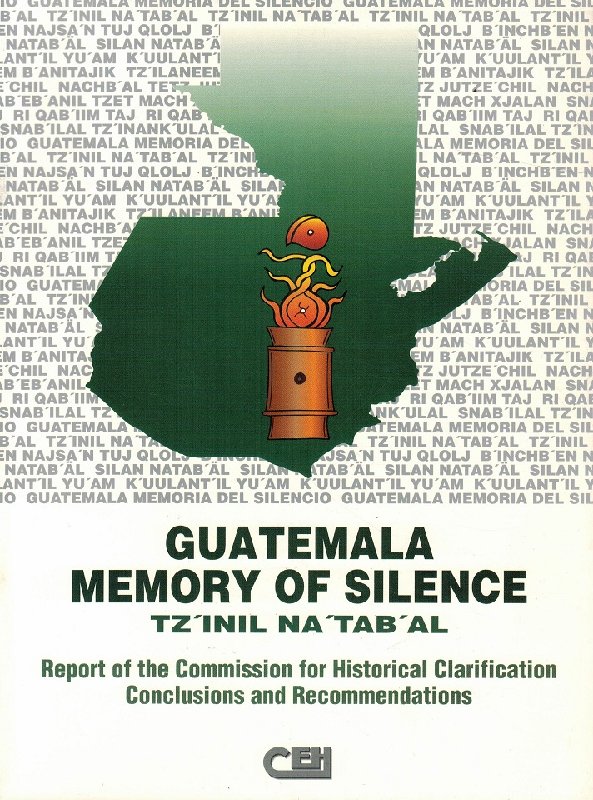
The Guatemala: Memoria del Silencio (Memory of Silence) report, produced in 1999 by the Comisión para el Esclarecimiento Histórico (Commission for Historical Clarification) (CEH), is the main primary source I used to understand the violence of the Guatemalan Civil War. The CEH was created in 1994 as part of the peace accords and was tasked with investigating human rights abuses committed during the 36-year conflict. Using thousands of testimonies, government records, and forensic evidence, the report documents the scale and patterns of violence carried out throughout the war. It was produced at a time when Guatemala was beginning to confront its past, and when survivors and human rights organizations were pushing for truth and accountability after years of silence and denial by the state. As an official truth commission report, it became a detailed and credible historical document, making it especially valuable for understanding how the violence was experienced and later documented.
The perspective of this source reflects an effort to center victims’ experiences while also formally assigning responsibility for the violence. The report is especially important for showing how Indigenous Maya communities were disproportionately targeted during military campaigns. It makes clear that acts such as massacres, disappearances, and forced displacement were not isolated events, but part of a broader pattern of systematic repression carried out by the Guatemalan government and state forces. The CEH also highlights how racism and government authority shaped this violence, showing that Indigenous identity itself often made people targets. This source connects directly to my research question because it not only documents the scale of violence, but also reveals how Indigenous experiences were silenced during the war and only fully acknowledged years later. By directly placing responsibility on the government and recognizing these patterns, the report challenges earlier narratives and helps explain how silence and denial shaped both the conflict and its aftermath.
“The Commission for Historical Clarification (CEH) concludes that the structure and nature of economic, cultural and social relations in Guatemala·are marked by profound exclusion, antagonism and conflict – a reflection of its colonial history. The proclamation of independence in 1821, an event prompted by the country’s elite, saw the creation of an authoritarian State which excluded the majority of the population, was racist in its precepts and practises, and served to protect the economic interests of the privileged minority. The evidence for this, throughout Guatemala’s history, but particularly so during the armed confrontation, lies in the fact that the violence was fundamentally directed by the State against the excluded, the poor and above all, the Mayan people, as well as against those who fought for justice and greater social equality.
…
After studying four selected geographical regions, (Maya-Q’anjob’al and Maya-Chuj, in Barillas, Nenton and San Mateo Ixtatan in North Huehuetenango; Maya-lxiI, in Nebaj, Cotzal and Chajul, Quiche; Maya-Kiche’ in ]oyabaj, Zacualpa and Chiche, Quiche; and Maya-Achi in Rabinal, Baja Verapaz) the CEH is able to confirm that between 1981 and 1983 the Army identified groups of the Mayan population as the internal enemy, considering them to be an actual or potential support base for the guerrillas, with respect to material sustenance, a source of recruits and a place to hide their members. In this way, the Army, inspired by the National Security Doctrine, defined a concept of internal enemy that went beyond guerrilla sympathisers, combatants or militants to include civilians from specific ethnic groups.”
Source:
Comisión para el Esclarecimiento Histórico (CEH). Guatemala: Memoria del Silencio (Memory of Silence). Guatemala City: CEH, 1999. https://hrdag.org/wp-content/uploads/2013/01/CEHreport-english.pdf