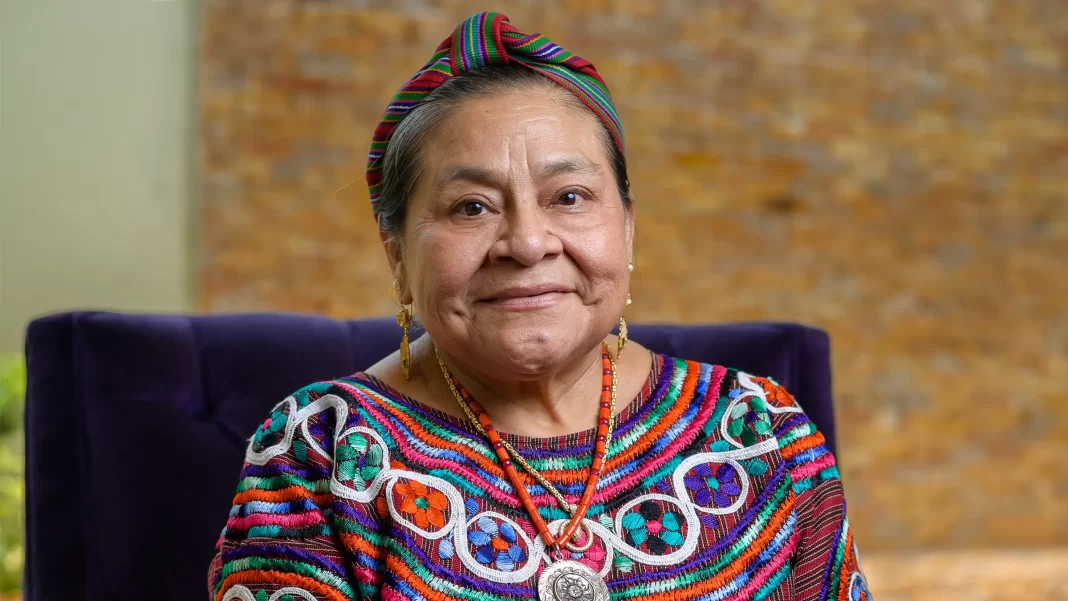
This primary source is a testimonial narrative published in 1984 that shares the personal experiences of Rigoberta Menchú, an Indigenous K’iche’ Maya woman who grew up in rural Guatemala during the Guatemalan Civil War. The book, I, Rigoberta Menchú, was created through a series of interviews conducted by Elisabeth Burgos-Debray while Menchú was living in exile. It describes the conditions faced by Indigenous communities, including poverty, forced labor on plantations, and increasing violence carried out by the Guatemalan military against civilians suspected of supporting insurgent groups. Menchú recounts witnessing the destruction of villages, the imprisonment and killing of family members, and the suppression of Indigenous cultural traditions. The testimony was created to share the lived experiences of Indigenous Maya people with an international audience and to bring attention to the violence that many government officials denied or minimized during the war. By documenting these experiences, the source highlights the widespread fear and suffering that shaped daily life for Indigenous families during the height of military repression in the late 1970s and early 1980s.
The perspective of this source reflects the viewpoint of an Indigenous survivor who directly experienced the effects of government violence and discrimination. Unlike official reports created by government agencies, Menchú’s testimony focuses on the emotional, cultural, and personal consequences of violence, showing how entire families and communities were affected. Her account also reflects the silencing of Indigenous voices, as many communities were unable to report abuses due to fear of retaliation from military forces. The source is historically significant because it provides a firsthand account of how violence and repression affected Indigenous Maya communities and reveals how personal testimony helped expose injustices that were ignored or denied by those in power. This source connects to my project by demonstrating how government violence shaped the everyday lives of Indigenous people and how sharing survivor testimonies played an important role in challenging official narratives and bringing global attention to the suffering that occurred during what is now widely referred to as the Guatemalan Silent Holocaust.
“The soldier began to cry and said: ‘It’s not my fault. They give me orders. They forced us to come here and if we don’t obey, they kill us.’ He said: ‘We take orders from a captain … If I go into the army, I’m an enemy of the people anyway, and if I lay down my arms, I’m the army’s enemy. If one side doesn’t kill me, the other will. I don’t know what to do.’ … And he told us a lot about how they tortured in the barracks. He said: ‘From the first day I arrived in the barracks, they told me that my parents were stupid,’ – he was an Indian too – ‘that they were stupid because they couldn’t speak and that they’d teach me how people should speak. So they started teaching me Spanish … Then they told me I had to kill the communists from Cuba and Russia. I had to kill them all and they gave me a gun.’ But we asked him: ‘And who do you kill with this gun? Why are you hunting us? Do they say that if your father or mother are on the other side, you must use this gun to kill them too?’ ‘I use this gun the way they tell me to use it. I’m not to blame for all this, they just grabbed me in the town.’ He cried and we felt sorry for him, because we are all human.
By that time I understood the position very well. I knew it wasn’t the fault of the soldiers. The government force our people to be soldiers too … ‘We have to obey the captain. The captain is always behind us and if we don’t obey, he shoots us.’ We asked him: ‘And why don’t you get together then if there’s only one captain.’ ‘Well, not all of us think the same,’ he said, ‘many have come to believe in what we’re doing.’ And we asked him: ‘And what are you defending? Where are these communists?’ The soldier didn’t even know what communists were. We asked him ‘What do communists look like?’ And he said: ‘Well, they tell us they’re in the mountains, that they don’t look like people, and things like that.’ He had no idea of what he was doing, Then we said to him: ‘You are defending the rich. You are defending authority. You’re not defending your own people.’ … ‘If you are a true son of your people, if you really remember the advice of our ancestors, you must go and make a life where you can, but stop being a criminal. Don’t go on killing.’ …
My dream was to go on fighting and getting to know my people more closely. At the same time I was very concerned that everything handed down from our ancestors should still be practiced. And even though the tortures and kidnappings had done our people a lot of harm, we shouldn’t lose faith in change.”
Source:
Menchú, Rigoberta. 1984. I, Rigoberta Menchú. Edited by Elisabeth Burgos-Debray. London: Verso.