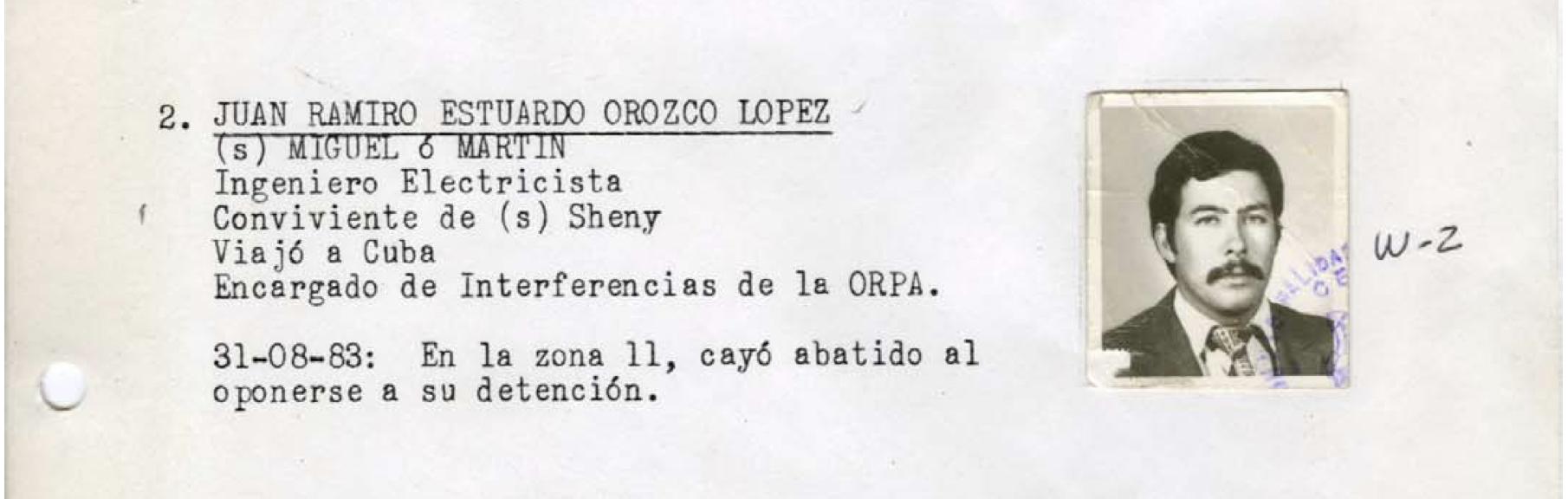
This is a source created by Guatemalan Military Intelligence between 1983 and 1985 that was later leaked and analyzed by Kate Doyle in 1999. The death squad diary, known as the Diario Militar, is a 74-page document that recorded information on 183 Guatemalans, ranging from students to labor organizers and human rights activists, who were abducted, forcibly disappeared, or executed by members of the state during the Guatemalan Civil War. The document reveals the final moments of these individuals, including their names, photographs, alleged affiliations, and coded notations indicating whether they were captured, tortured, killed, or “disappeared.” Many entries include abbreviations that served as shorthand for execution or ongoing detention. As a result, this source provides direct evidence created by the Guatemalan military itself, showing how disappearances were recorded and organized as part of state violence.
The Diario Militar is accompanied by Kate Doyle’s article, which explains how the document is structured and helps interpret its coded language. Doyle describes how military intelligence officials compiled detailed files on each individual, often using photographs taken from identification documents such as passports or licenses. She also explains how the codes and annotations reveal patterns of surveillance, capture, and execution, demonstrating that these acts were not random but part of an organized system. Her analysis makes it clear that the document functioned as an internal record for tracking detainees and controlling information about their fate. By decoding these entries, Doyle shows how the military documented its own role in disappearances while keeping that information hidden from the public.
The perspective of this source is especially significant because it reflects the viewpoint of the perpetrators rather than the victims or outside observers. Unlike other sources that report on violence or question its extent, this document directly records the actions of state forces responsible for disappearances. This makes it historically important as evidence of how violence was carried out and concealed by the Guatemalan government. The source connects to my project by demonstrating how disappearances were used as a deliberate strategy to silence civilians, particularly those seen as political threats, and how these hidden records later became crucial evidence in exposing the scale of government violence during what is now widely referred to as the Guatemalan Silent Holocaust.
From Kate Doyle’s document deciphering the Diario Militar:
“During Guatemala’s 35-year civil war, which ended in 1996, the term “to disappear” had a special significance: it meant abduction, torture, and execution at the hands of the Guatemalan security forces. By the time a peace accord was signed, over 150,000 people were dead, and some 40,000 Guatemalan citizens had vanished, leaving family and friends to grieve without even a corpse to bury. The Guatemalan government has consistently denied knowledge of its victims’ fates; it can do so no longer. This document, smuggled out of the military’s own archives in February just two days before a Guatemalan “truth commission” published its findings, lists 183 names (of which Teresa Graciela Samayoa Morales’s is the first), each carefully catalogued in what amounts to a daily log of death squad activities. This list is the only known record of its kind, an accounting from inside the secret files of Guatemala’s killing machine.
Juan Ramiro Estuardo Orozco López, an electrical engineer who lived with Samayoa Morales (alias Sheny), was killed two days after her disappearance while resisting his own abduction. His connection to another victim is not unusual; the list contains lovers and spouses, mothers and daughters, sisters, brothers, fellow students, and colleagues. There are 24 women and 159 men, ranging in age from 81 to 12. Ten victims were professors or students at the University of San Carlos, a frequent target of death squad activity. Nine were labor activists. Others were doctors, lawyers, merchants, a carpenter, a housewife. According to the document, every one of them belonged to a guerrilla faction; the military assumed that anyone who worked for social change or who was active in leftist politics was a subversive.”
Sources:
Guatemalan Military Intelligence. 1983–1985. Diario Militar (Death Squad Dossier), August 1983–March 1985. Guatemala City: Guatemalan Army Intelligence Unit. https://nsarchive2.gwu.edu/NSAEBB/NSAEBB15/dossier-color.pdf
Doyle, Kate. June 1999. “The Death Squad Diary.” Harper’s Magazine. https://nsarchive2.gwu.edu/NSAEBB/NSAEBB15/death_squad_harpers.pdf